Introduction
There are products you see everywhere.
Instagram, YouTube, influencers, and ads.
They’re presented as must-haves, revolutionary, premium.
But one simple question is enough:
Does their performance really justify their reputation?
At Ustensil’Home, we don’t tear products apart.
We tear illusions apart.
Before talking about overrated utensils, we need to remind ourselves of one simple thing:
a good kitchen doesn’t depend on a multitude of gadgets.
With a few reliable tools, you can make the vast majority of preparations.
The basics have been the same for a long time:
a good chef’s knife to cut and prep ingredients
a solid frying pan to sear and cook most foods.
a reliable saucepan for sauces, pasta, and vegetables.
a stable cutting board.
a few simple utensils like a spatula, a whisk, or a wooden spoon.
That’s exactly why some modern gadgets now seem…
hugely overrated!
1- Virality:
the new proof… that isn’t one.
A product can become famous in just a few days.
Why?
Because social media loves visual demonstrations:
- an egg sliding around in a pan.
- a gadget that chops an onion in one second.
- a device that promises to replace 10 utensils.
- These videos are effective.
But they show staging, not everyday use.
In a real kitchen:
- durability matters.
- simplicity matters.
- reliability matters.
Three things marketing rarely shows.
2- The “revolutionary” product trap.
Today, almost every new utensil is presented as a revolution.
You see promises like:
- next-generation technology.
- exclusive innovation.
- professional design.
never-before-seen performance.
The problem is that these words often don’t mean anything specific.
In many cases, the product simply uses a technology that’s existed for a long time, just presented under a new name.
For example:
- some “revolutionary” pans use the same non-stick principle as for decades.
- some cutting gadgets simply reuse systems already found on classic mandolines.
- some cooking appliances are just compact versions of already well-known technologies.
- Innovation does exist sometimes.
But in many cases, what’s new isn’t the technology.
It’s the way it’s sold.
3- Gadgets that replace…
what already works.
One of the most effective marketing techniques is to take a simple task… and create a gadget that’s supposed to revolutionize it.
- Chopping an onion.
- Grating a carrot.
- Peeling a fruit.
These actions have always existed in the kitchen.
Yet every year, new objects appear to “reinvent” them.
The problem isn’t that they work badly.
The problem is that they often replace tools that are already perfectly effective.
The multifunction vegetable chopper.
Very popular on social media, this type of gadget promises:
- perfect cubes.
- vegetables cut in a few seconds.
- spectacular time savings.
In demonstrations, everything looks simple.
But in a real kitchen:
- some blades dull quickly.
- the mechanisms can break.
- cleaning is often time-consuming.
Meanwhile, one tool has already been doing this job forever:
- the chef’s knife -
Simple, sturdy, precise, and used in all professional kitchens.
The “revolutionary” rotary mandoline.
You often see modern versions with:
- Multiple drums.
- a rotating system.
- promises of ultra-fast slicing.
These devices can be handy.
But the reality is simpler:
- The classic mandoline has been around for a long time and already does this job precisely.
Once again, innovation is sometimes real.
But what’s new isn’t always the function.
It’s often the way it’s presented.
Meat shredding claws.
This tool looks like two large metal claws used to shred meat, especially pork or chicken.
Marketing says it allows you to:
- Shred meat quickly.
- Avoid burning yourself.
- Get a perfect texture.
In reality, this task is very easy to do with two forks.
It’s also the method that’s been used for a long time in professional kitchens.
The claws work, but they don’t do anything two forks can’t already do.
Once again, the object doesn’t invent a new technique.
It simply turns a simple action…
into a specialized gadget.
Ultra-specialized gadgets.
Some objects are designed for a single very specific task:
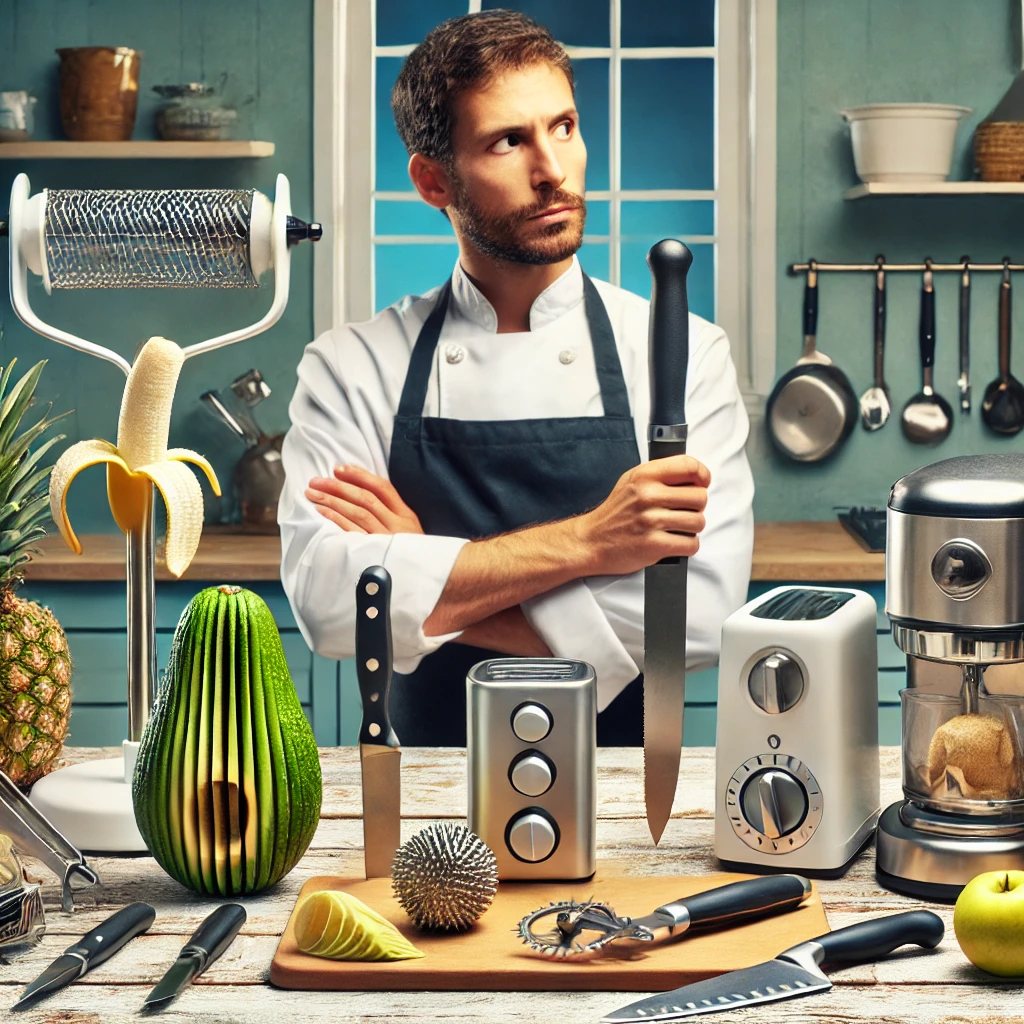
- Avocado slicer.
- Pineapple peeler.
- Egg yolk separator.
- Strawberry slicer.
They can be fun, that’s for sure!!
But in most kitchens, these objects quickly end up in a drawer.
Why?
Because a versatile tool often does the same thing:
- A knife.
- A spoon.
-A cutting board
4- The trap of useless items
In the world of kitchen utensils, some products aren’t bad.
They’re simply… useless!!
So you see tools dedicated to:
- Cutting an avocado.
- Separating an egg yolk.
- Shredding meat.
- Slicing strawberries.
The problem is obvious:
these tasks are already done perfectly with basic utensils.
- A knife.
- A spoon.
- A fork.
These objects don’t revolutionize cooking.
They simply create a new thing to buy.
That’s what we call the trap of useless items.
Gadgets designed to impress in a demonstration… but rarely used in a real kitchen.
So never forget….
fewer items,
but better tools.